Facilities: Optical spectroscopy
Our laboratories in the SEE building include modern facilities for Raman spectroscopy, photoluminescence spectroscopy, electroluminescence spectroscopy and single photon counting experiments. We use these facilities primarily for our research into extreme conditions, quantum technologies and photovoltaics. Our facilities are able to investigate the dependence of optical spectroscopy on a wide range of experimental parameters. In particular, we support:
- Continuous wave, nanosecond and femto-second pulsed laser excitation between 400 – 900 nm
- Spectral measurement from VIS to telecoms -> 400 – 1550 nm
- Single photon statistics between 400 – 900 nm
- 2d-spatial scanning with ~1 micron resolution
- Optical microscopy imaging up to 100x magnification
- Raman spectroscopy with 532nm excitation
- Temperature dependent measurements between 4 and 450K
- Pressure dependent measurements up to 100 GPa
Collectively, these techniques have applications tackling a range of scientific and engineering challenges. For example, they can be used to measure the electronic energy levels of solids, detect otherwise elusive light molecules such as hydrogen or methane, and investigate phenomena such as amorphization under extreme conditions.
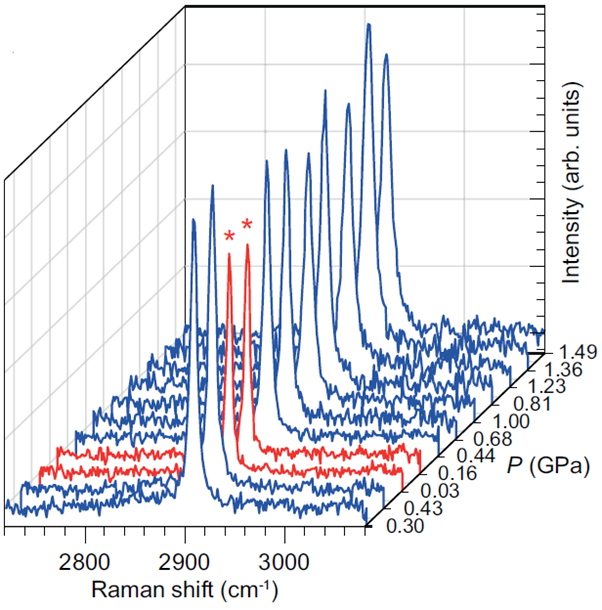
In recent years, we have used our optical spectroscopy facilities to study perovskite solar cell materials, hydrogenation of nickel nanoparticles and graphene, and to support sample preparation and our research at central facilities such as ISIS and the European Synchrotron Radiation Facility.
Work with us
We are available to perform contractual / consultancy work for external users and actively seek new academic collaborations. Optical spectroscopy also forms a key part of many Ph.D. and M.Res. projects undertaken in the group. If you are interested, please contact j.e.proctor@salford.ac.uk to enquire about using our optical spectroscopy facilities, or read about postgraduate research opportunities.