We delighted to welcome Associate Professor Barbara Barrow, from the University of Lund to this trimester’s guest speaker slot, on Wednesday 1 April from 2:30 to 4:30pm. All are welcome — please email the organiser Scott Thurston if you wish to attend (S.Thurston@salford.ac.uk) — online option available too.
The abstract for Barbara’s fascinating talk is below…
“‘So what is he then? A fish sadist?’”: Anthropomorphism and Aquariums in Creative-Critical Practice
Aquariums have a troubled ecological history, holding animals captive, acting as technologies of display, and reinforcing an unequal dynamic in which humans gaze upon the monstrous marine. On the other hand, aquariums can also facilitate transcendent encounters between humans and marine life, creating, as Eva Hayward writes, a “sensuous rapport” that invites recognition of animal agency and shapes and remakes the human aquarium-goer (“Sensational Jellyfish,” 2012, pp.165-168). In this practice-based, critical-creative talk, I share the research I conducted on the cultural and literary history of the aquarium as part of my book, Victorian Literature, Queer Longing and the Shore, 1840–1920 (forthcoming, Edinburgh University Press). I show how this sensuous rapport plays out across diverse forms of media, from the playful writing of Victorian naturalists and their breathtaking underwater illustrations to poignant moments of human-marine identification in literary texts. In the second part of my talk, I reflect on my experience conducting this research while frequenting a chain pet store with an aquarium display, an experience that inspired my short story, “Bettas” (Faultline, 2022). In this story, a flamboyant betta fish mediates an unlikely friendship between Judith, an eccentric PetLuv employee, and Ruby, a new, grieving coworker. I will read selected passages aloud as instances of an anthropomorphism that seeks not to reduce marine life through human comparison but, as Jane Bennett writes, to challenge anthropocentrism by finding “a whole world of resonances and resemblances” (Vibrant Matter, 2009, p. 99). In this story, human-fish encounters are generative points for developing character interiority and conflict, but also moments that seek to honor the vitality of the underwater world.
Dr Barbara Barrow is a senior lecturer and docent in English literature. Her research interests include nineteenth-century literature and culture, women, gender, and sexuality, critical and feminist pedagogies, and the environmental humanities, especially the blue humanities. Before coming to Lund, she taught at universities in Pittsburgh, St. Louis, and Beijing.
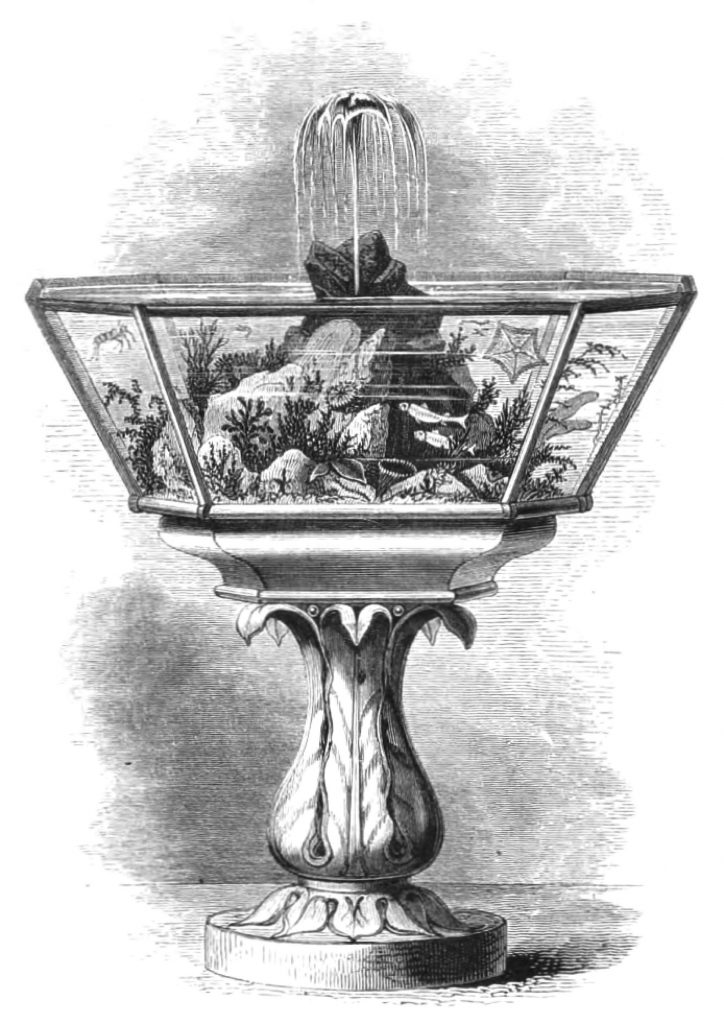
Image below and featured in banner: from Philip Henry Gosse’s The Aquarium, 1856, in the public domain.